
Introduction: AI Training Is Only the Beginning
Artificial Intelligence is transforming how organisations operate, make decisions and deliver business value. Enterprises across industries are investing in AI training and upskilling programmes to prepare their employees for an increasingly AI-driven workplace.
However, an important question remains:
How do organisations know whether their employees can actually apply the AI skills they have learned?
Training completion certificates, participation records and learning hours provide insights into employee engagement, but they do not necessarily demonstrate practical AI proficiency.
An employee may understand AI concepts but still struggle to use AI tools effectively, solve business problems or generate meaningful outcomes using AI.
Organisations therefore need to move beyond training completion and introduce structured ways to measure practical AI capabilities.
This is where ConceptNinjas helped an enterprise organisation strengthen its AI upskilling initiative by introducing a structured, technology-enabled approach to evaluating employee AI skills.
The Challenge: Measuring AI Capability Beyond Training Completion
As part of an enterprise-wide AI capability development initiative, the organisation wanted to understand how effectively employees could apply their AI knowledge in practical situations.
The objective was not simply to measure participation in training but to evaluate the actual capabilities demonstrated by employees. Some of the key challenges included:
Measuring practical AI proficiency
Understanding whether employees could translate AI concepts into practical applications.
Evaluating applied skills
Assessing how effectively participants could use AI tools to approach and solve problems.
Standardising evaluation
Establishing consistent assessment parameters across different learning modules.
Managing assessments at scale
Supporting structured evaluations without depending entirely on manual assessment.
Identifying capability gaps
Generating insights to help organisations understand areas requiring further development.
The organisation needed an assessment solution that could evaluate demonstrated skills rather than rely exclusively on theoretical knowledge or self-reported proficiency.
The Solution: ConceptNinjas' AI-Powered Skills Assessment Approach
ConceptNinjas supported the initiative through a structured assessment framework designed to evaluate practical AI knowledge and application. Instead of relying solely on conventional multiple-choice questions, the assessment approach incorporated practical exercises and structured evaluation parameters to understand how participants applied their AI skills.
The solution focused on five key areas.
1. Structured AI Skills Assessment
ConceptNinjas enabled structured assessments aligned with the programme's learning objectives.
Participants were evaluated through different assessment modules designed to examine their understanding of AI concepts and their ability to apply them.
This established a consistent evaluation framework and provided a structured way to measure individual performance.
2. Practical and Scenario-Based Evaluation
Understanding AI terminology is very different from knowing how to use AI effectively.
To bridge this gap, practical scenario-based assessments were incorporated into the evaluation process.
Participants were required to interpret requirements, approach tasks and demonstrate their ability to use AI-assisted problem-solving techniques. This helped assess practical capabilities rather than simply testing theoretical understanding.
3. AI-Driven Evaluation
A key component of the solution was technology-enabled evaluation of participant responses against predefined parameters. Depending on the assessment module, the evaluation framework considered:
Evaluation Framework Parameters
- Understanding of the problem statement.
- Quality and relevance of the approach.
- Effectiveness of AI tool utilisation.
- Accuracy and quality of the output.
- Ability to address requirements and edge cases.
- Problem-solving and iteration capabilities.
This approach helped establish a more structured and consistent evaluation process while reducing dependence on manual assessment.
4. Assessment Integrity and Monitoring
For enterprise assessment programmes, maintaining the integrity of the evaluation process is equally important.
ConceptNinjas incorporated proctoring and monitoring capabilities to identify events such as loss of focus and other assessment-related irregularities.
These capabilities provided administrators with additional visibility into assessment sessions and enabled the review of potential irregularities where necessary.
5. Performance Insights and Reporting
Assessment data becomes valuable when it helps organisations make better learning and development decisions. ConceptNinjas enabled centralised assessment reporting to provide visibility into participant performance across different modules. These insights could help organisations:
What Centralised Reporting Enables
- Understand individual assessment performance.
- Identify areas requiring improvement.
- Compare performance across different assessment modules.
- Recognise potential capability gaps.
- Plan targeted learning interventions.
The objective was to make assessment results useful beyond the evaluation exercise itself.
Training Completion vs. Measurable AI Readiness Assessment
| Dimension | Training Completion Metrics | ConceptNinjas AI Assessment |
|---|---|---|
| What is measured | Course attendance, learning hours, and completion certificates | Demonstrated AI proficiency, applied workflows, and output quality |
| Task format | Self-reported proficiency or theoretical multiple-choice quizzes | Practical, scenario-based exercises mirroring real business problems |
| Evaluation consistency | Manual grading or unstandardised review across cohorts | AI-driven evaluation scored consistently against predefined parameters |
| Session integrity | Limited visibility into how assessments were completed | Proctoring and focus monitoring with actionable irregularity review |
| L&D decision value | Participation logs with minimal insight into capability gaps | Centralised module-level reporting to guide targeted learning interventions |
The Implementation: A Structured Assessment Journey
The engagement followed a phased approach to support the assessment initiative.
Assessment Design
Assessment modules were aligned with the programme's objectives and the AI capabilities that needed to be evaluated.
Assessment Deployment
Assessments were configured and published on the ConceptNinjas platform, creating a structured digital assessment environment.
Participant Evaluation
Participants completed their assigned assessments, demonstrating their understanding and practical application of AI skills.
Monitoring and Continuous Improvement
Assessment performance, participant feedback and platform observations were reviewed. Improvements were introduced to enhance the assessment experience, including monitoring alerts and navigation.
Reporting and Insights
Assessment results were consolidated to provide visibility into participant performance and support further capability development.
The Impact: Moving Towards Measurable AI Readiness
The initiative demonstrated the importance of introducing structured assessment into enterprise AI upskilling programmes. With ConceptNinjas, the organisation could move towards a more evidence-based approach to understanding workforce AI capabilities.
Visibility Beyond Learning Completion
Organisations could look beyond training attendance and assess demonstrated AI capabilities.
More Structured Evaluation
Predefined assessment parameters helped establish consistency across the evaluation process.
Practical Skill Validation
Scenario-based exercises provided opportunities to evaluate the application of AI knowledge rather than relying exclusively on theoretical questions.
Scalable Assessment Operations
A centralised digital assessment platform supported the administration and monitoring of structured evaluations.
Actionable Learning Insights
Performance reporting provided a foundation for identifying development areas and planning future learning interventions.
Ultimately, the initiative reinforced an important principle: AI readiness should be measured through demonstrated capability, not simply learning participation.
Industry Recognition: The Growing Importance of AI-Ready Workforces
The enterprise AI upskilling initiative supported through this collaboration was part of a broader commitment to building a future-ready workforce.
The organisation's efforts received recognition at the SHRM HR Excellence Awards 2026, winning in the Excellence in Learning & Development – MSME category.
This recognition reinforces the growing importance of investing in employee development, AI adoption and measurable workforce capabilities. For ConceptNinjas, being part of this journey was an opportunity to contribute to a larger objective: helping organisations move beyond AI training completion towards structured assessment and measurable AI skills.
It also reflects an important shift in enterprise learning and development: successful AI transformation requires not only training employees but also understanding how effectively they can apply what they have learned.
Why Enterprise AI Upskilling Needs an Assessment Layer
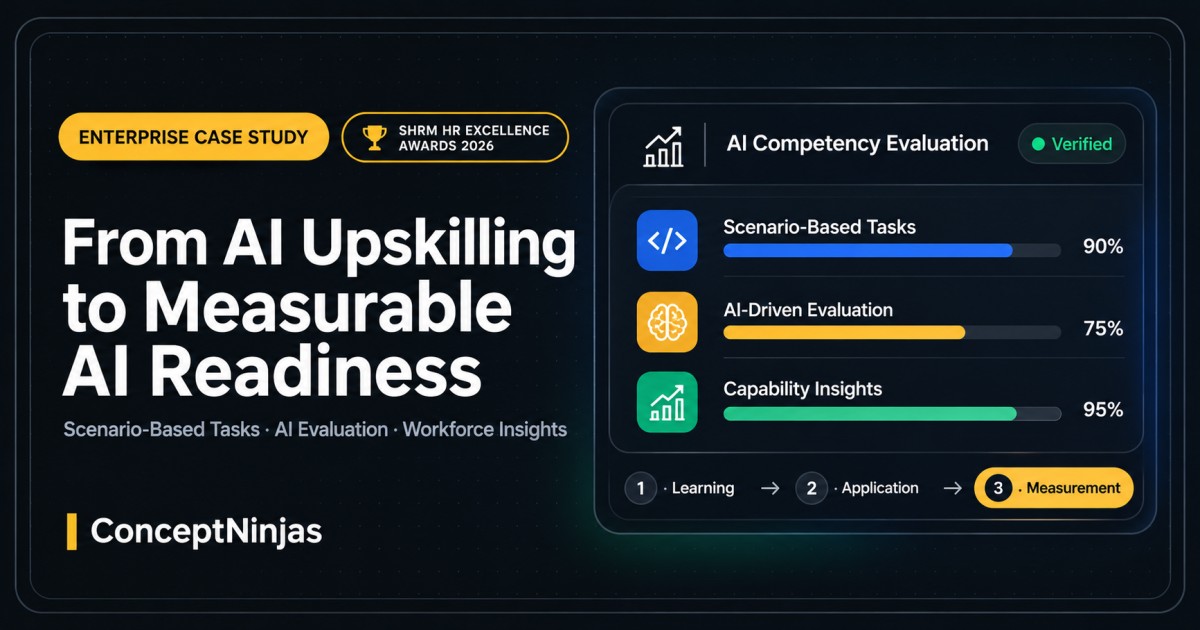
As organisations continue to invest in AI transformation, the ability to measure workforce readiness will become increasingly important. An effective enterprise AI upskilling strategy should bring together three essential elements:
1. Learning
Equip employees with the knowledge and skills required to use AI.
2. Application
Provide opportunities to demonstrate those skills through practical exercises.
3. Measurement
Evaluate performance and identify areas for continuous improvement.
Without measurement, organisations may struggle to understand whether their AI training investments are translating into practical workforce capabilities.
An AI-powered assessment platform can bridge this gap by providing structured evaluation, consistent assessment parameters and performance insights. Learn more in our guide on how to measure training effectiveness.
How ConceptNinjas Helps Organisations Measure AI Skills
At ConceptNinjas, we believe that the future of workforce development lies in combining learning with measurable skill outcomes. Our AI-powered assessment platform helps organisations evaluate technical capabilities, practical problem-solving and applied AI skills through:
AI Skills and Competency Assessments
Evaluate employee understanding and proficiency across relevant AI capabilities.
Scenario-Based Practical Evaluations
Assess how effectively participants apply knowledge to real-world tasks.
AI-Assisted Coding and Problem-Solving Tasks
Evaluate practical technical skills and AI-assisted workflows.
Automated AI-Driven Evaluation
Assess responses against predefined evaluation parameters.
Proctored and Non-Proctored Assessments
Support different enterprise assessment requirements.
Centralised Performance Reporting
Provide insights into participant performance and potential capability gaps.
Whether an organisation is building AI capabilities across its workforce, preparing employees for emerging technology roles or measuring the outcomes of an enterprise upskilling initiative, ConceptNinjas helps turn skill development into measurable assessment outcomes.
Don't Just Train Your Workforce. Measure Its AI Readiness.
The success of an AI transformation initiative should not be measured only by the number of employees trained or courses completed. Organisations also need to understand whether their workforce can confidently and effectively apply AI in everyday business scenarios.
Moving from AI learning to AI readiness requires a structured approach to assessment, practical evaluation and continuous measurement. With ConceptNinjas, organisations can take a more measurable approach to building an AI-ready workforce.
Ready to Measure Your Organisation's AI Readiness?
Discover how ConceptNinjas can help your organisation assess AI skills, evaluate practical capabilities and measure workforce readiness.